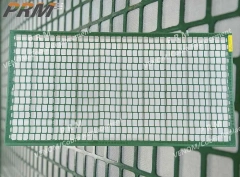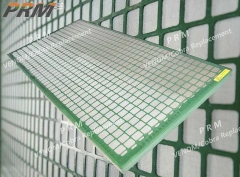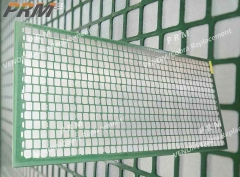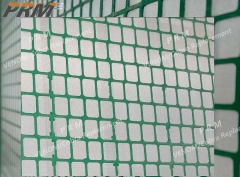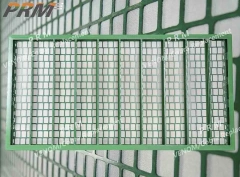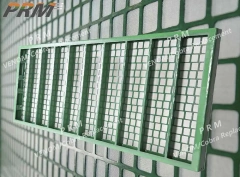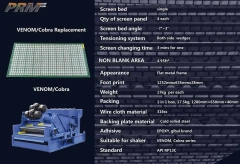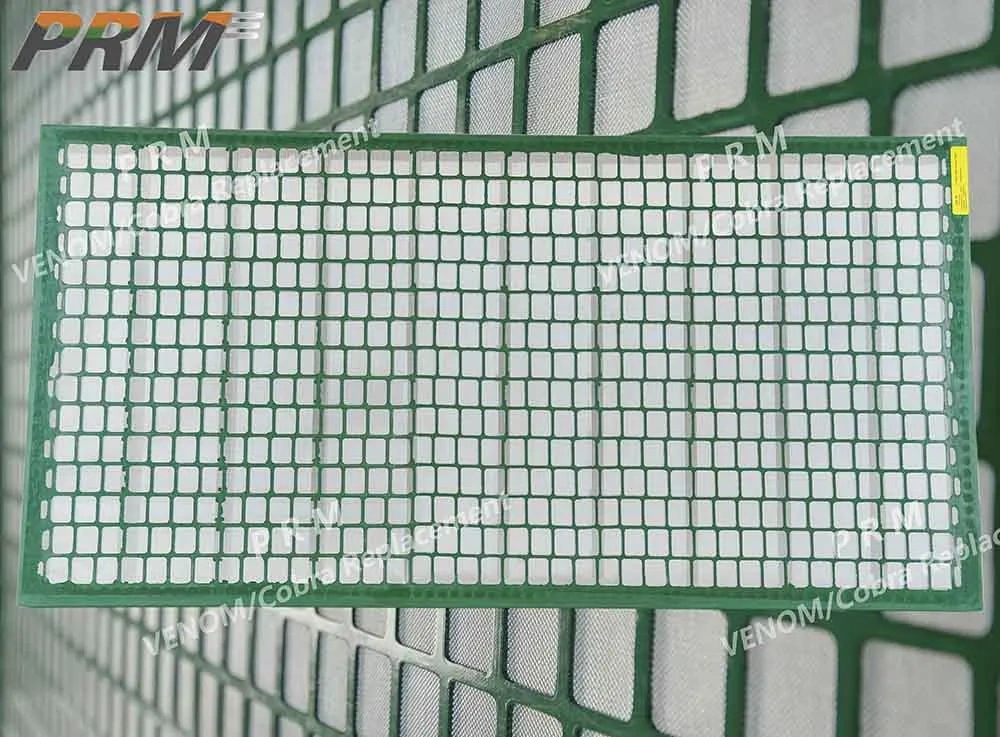
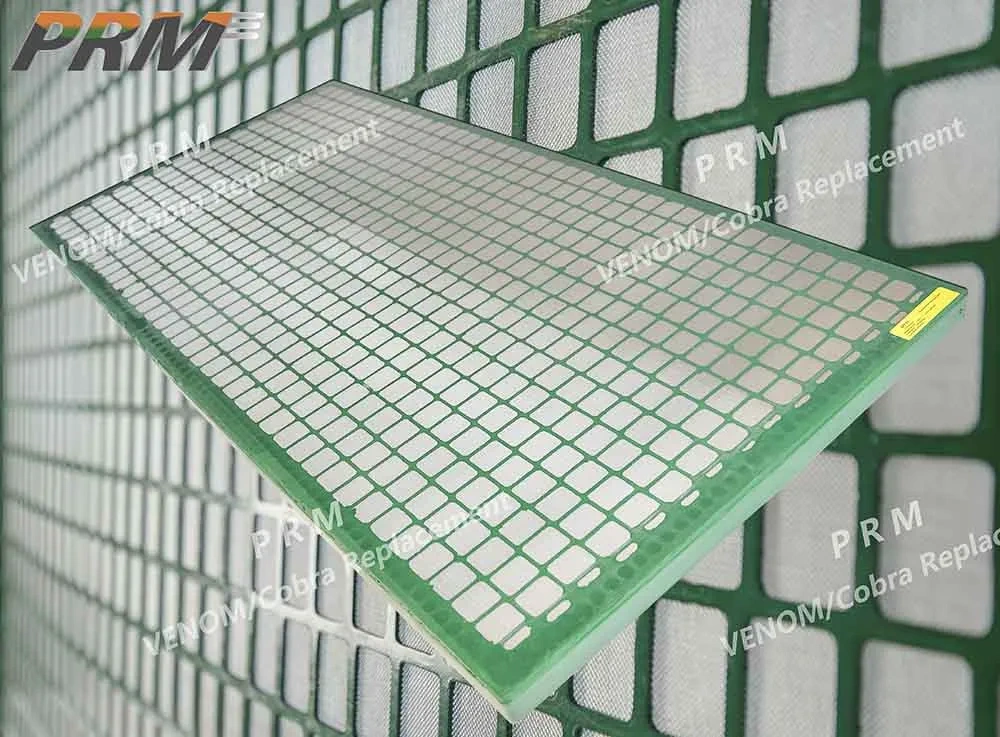
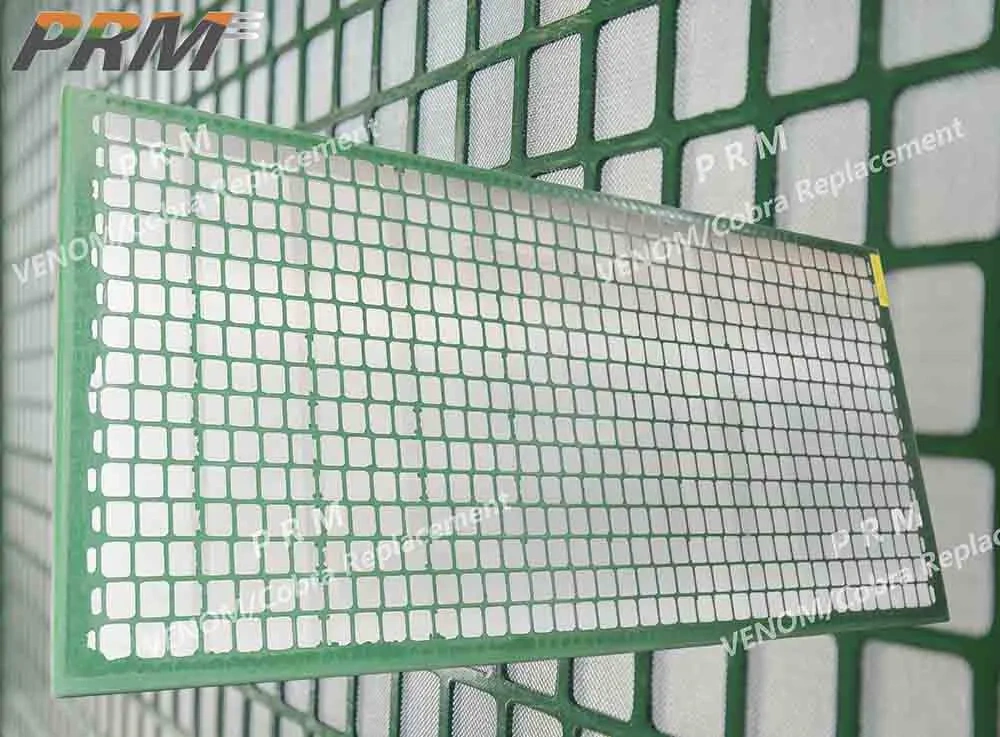
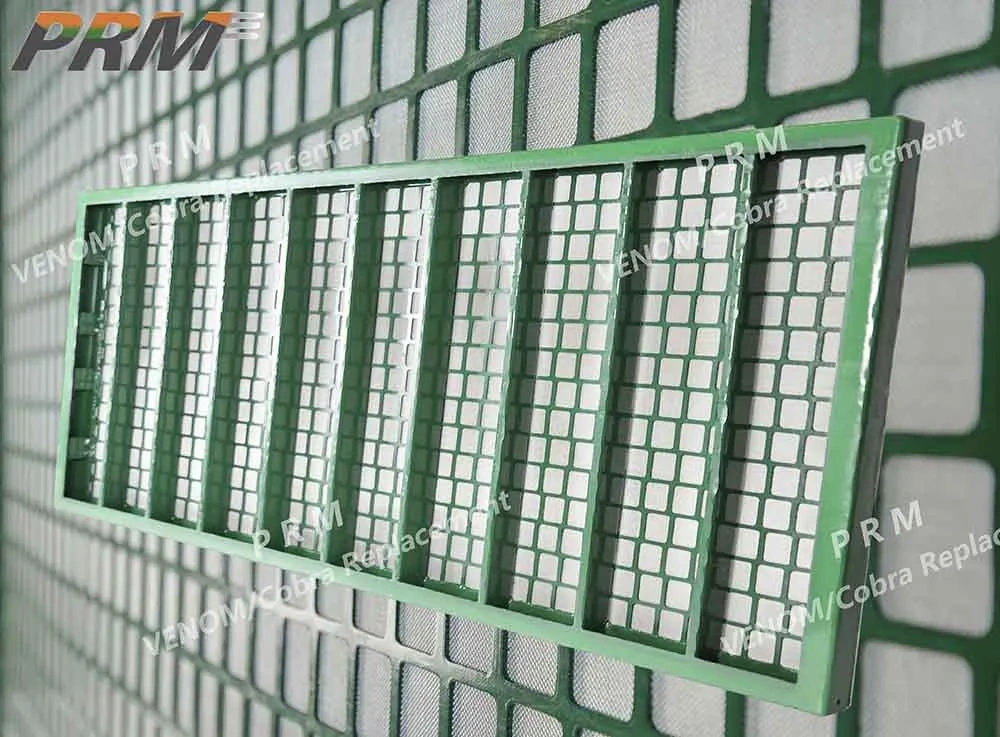
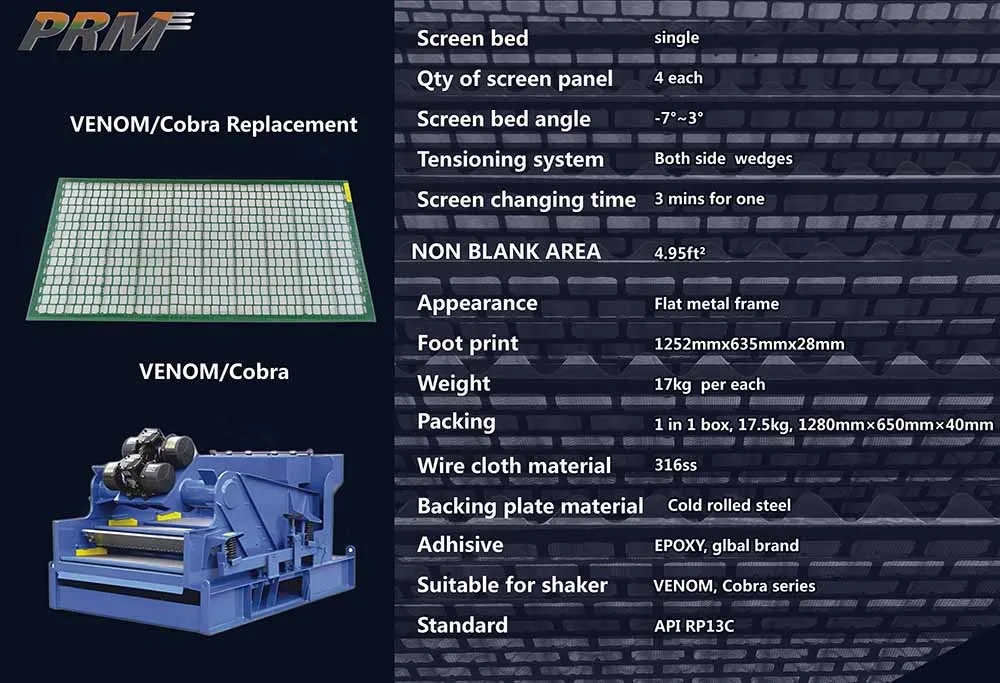


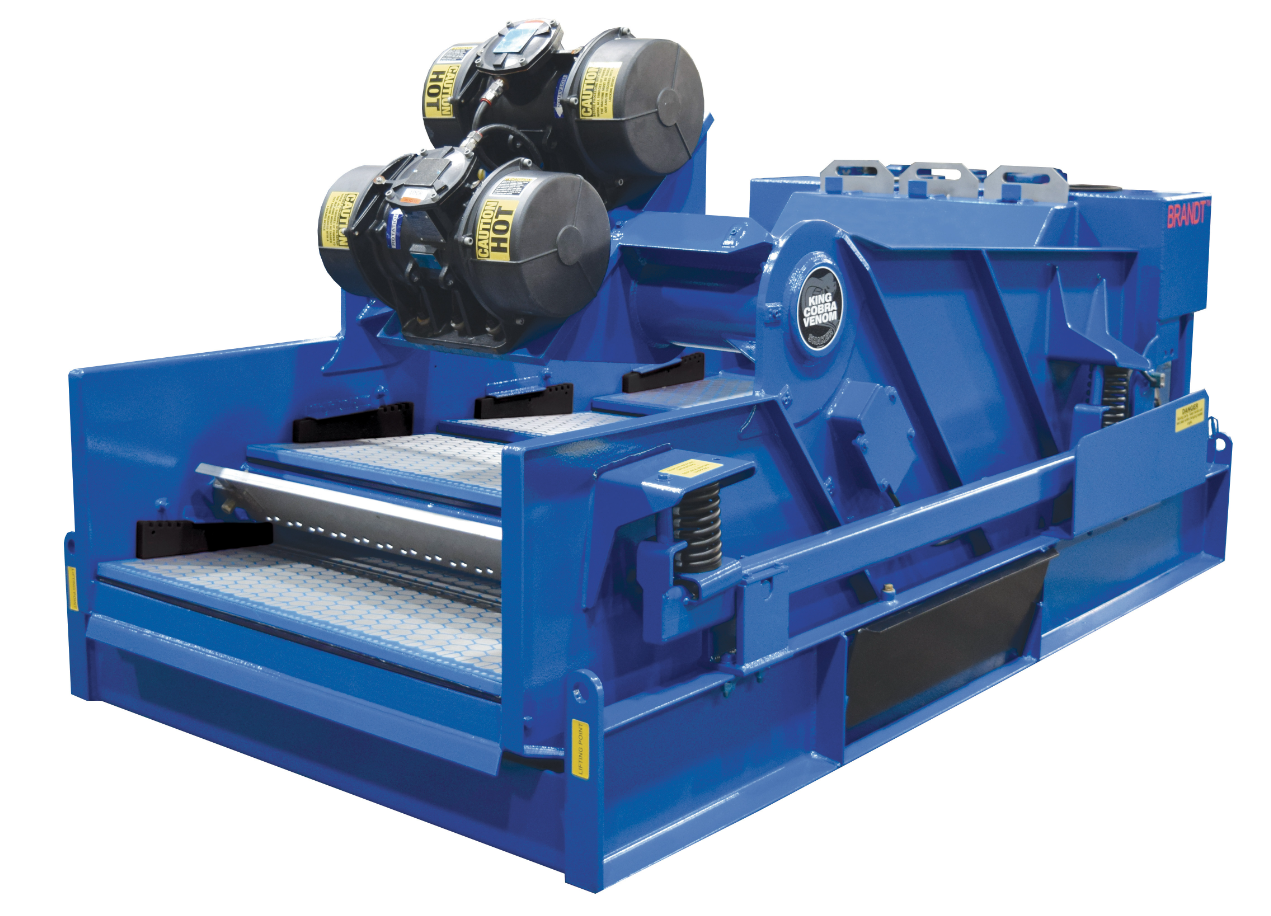
The Venom Cobra Replacement Shaker Screen is the flat metal panel that sits on the NOV Venom, King Cobra and Cobra decks. Each panel is built around a welded steel square-tube frame with an epoxy coating, a perforated cold-rolled steel backing plate, and 316 stainless steel wire cloth. The frame carries the load and keeps the working surface flat. The plate spreads the impact of falling cuttings. The cloth makes the cut. Two people change a panel in about three minutes, which is the number that matters when the deck is down and the mud is sitting in the pits. These shaker screen panels are built for offshore platforms and land rigs alike, on oil-based and water-based systems, and they are handled by hand at the rig floor rather than in a workshop. If your machine has been re-decked, or your deck carries a different panel count from the standard four, tell us before you order and we will check the fit against the drawing. Treat it as a consumable replacement shaker screen rather than a capital item: it wears, it gets changed, and the deck keeps running.


Rigidity on a Wide Panel
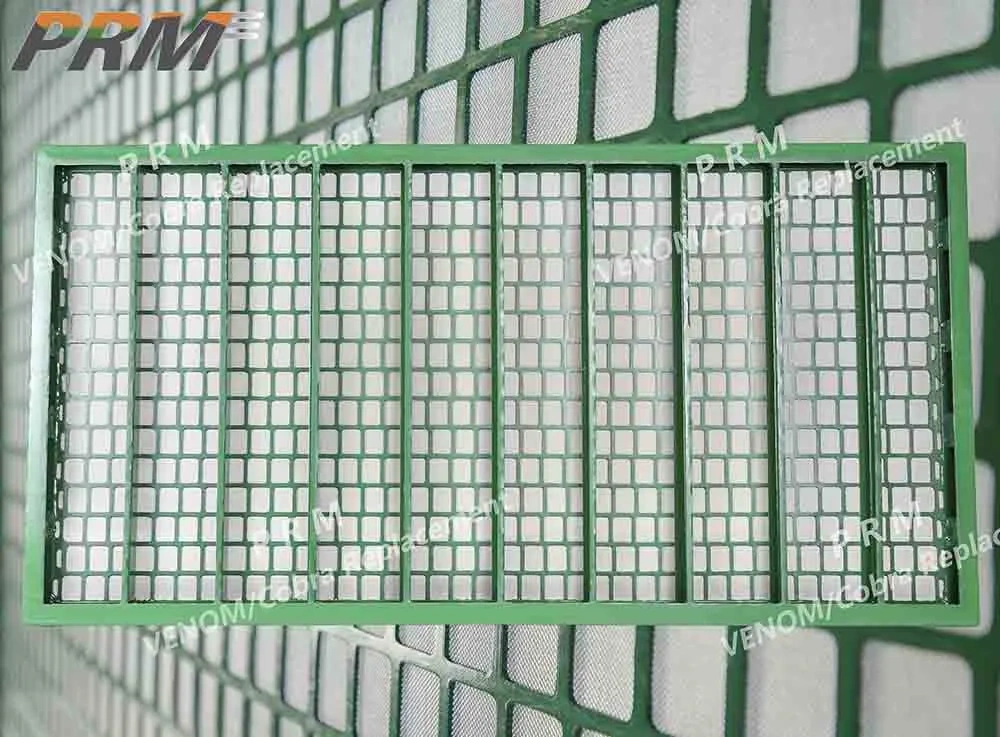
A panel this wide asks a lot of its frame, and that is the design problem behind all of our metal frame shaker screens. The deck grips it at the edges and shakes it at speed, so any flex in the middle shows up as cloth that works loose, blinds in patches or tears along a beam line — the weakness a shaker screen parts supplier cannot ignore. The frame is welded steel square tube with as many cross beams under the cloth as the panel depth allows, tying the long edges together so the working surface stays flat through the shake cycle instead of oil-canning between supports.
A Backing Plate That Spreads the Load
Under the cloth sits a perforated cold-rolled steel plate, bonded to the frame and to the mesh with epoxy. It does two jobs. It spreads the impact of falling cuttings across the panel instead of concentrating it on a handful of wires, and it holds the cloth in one plane so the cut stays the same from edge to edge.
Cloth That Suits the Service
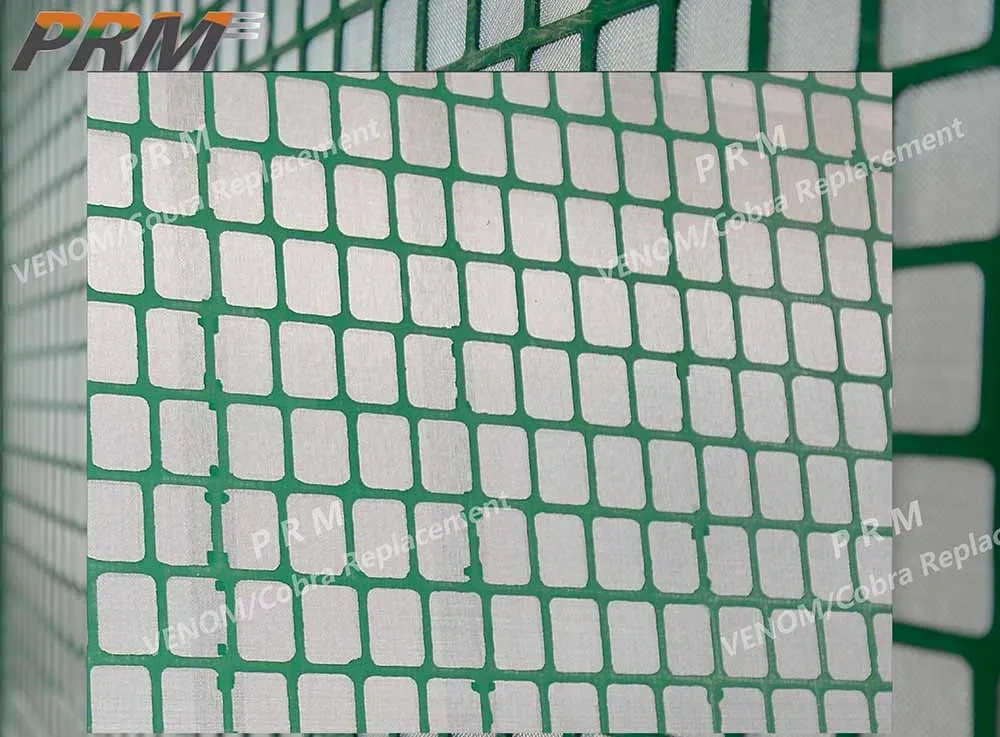
The wire cloth is 316 stainless steel, chosen for the chloride load in produced water, seawater wash-down and heavy brine, and woven in a fine square pattern so the aperture is predictable. The same alloy resists the pitting that shortens the life of lower-grade cloth in salt-heavy mud. Mesh is designated to API RP13C, so the number in your existing stock list translates directly into what you order here.
A Surface Without Wrinkles
Bonding cloth to a plate over this width without a wrinkle is not a question of buying the right adhesive. It took a long run of trial panels to settle the tensioning and curing sequence that keeps the weave square across the whole area. A wrinkle looks harmless and is not: it changes the aperture in that band, so part of the panel cuts at a different size from the rest of it, and that band is usually where a tear starts.
Open Area Carried to the Edge
The openings run out to the frame rather than stopping short of it, so fluid does not pond on a blank margin and cuttings do not pack against the edge. The cloth is wrapped and bonded over the plate edge in a layered joint, which keeps the perimeter tight under vibration — and the perimeter is where most panel failures begin.
Why It Is Built This Way
The frame carries the load, the plate keeps the surface flat, the cloth makes the cut. This is the part of the build where a shaker screen manufacturer spends money or does not, and it is the reason the panel holds its shape in service instead of slowly going soft. These separation benefits can reduce waste and support lower operating costs and long-term sustainability goals.

| Property | Value |
|---|---|
| Panel footprint | 1251 mm × 635 mm (49.25 in × 25.00 in) |
| Frame | Welded steel square tube, flat profile, epoxy coated |
| Backing plate | Perforated cold-rolled steel |
| Wire cloth | 316 stainless steel |
| Bonding | Epoxy adhesive |
| Weight per panel | 17 kg |
| Panels per single deck | 4 |
| Non-blank area | 4.95 ft² |
| Tensioning | Both side wedges |
| Deck angle handled | -7° to 3° |
| Mesh standard | API RP13C |
| Shakers served | NOV Venom, King Cobra and Cobra series |
The Number That Matters Is Cost per Metre Drilled
A screen's unit price tells you very little on its own. What a drilling programme actually pays — and what wholesale shaker screens buyers need to compare — is panels per deck multiplied by decks per section, plus the mud that leaves the location with the cuttings. A panel that holds its cut for a full section and releases its fluid cleanly is cheaper than a lower-priced one that blinds halfway through. Where the Money Leaks
Fluid riding over a blinded panel is the expensive failure, because nobody sees it happen. Every barrel that leaves with the cuttings has to be built again from make-up product and then disposed of as waste. Retaining that barrel at the shaker saves on both sides of the ledger, and it is the simplest environmental gain available on the solids control side of the rig. Plan the Replacement Instead of Reacting to It
Shaker screens replacement treated as a scheduled line item — a deck set changed at a fixed interval, plus a small buffer for tears — costs less than chasing individual panels after they fail. A planned change happens at a convenient moment, not at three in the morning with the mud weight climbing. Panels wear unevenly across a deck, and the front positions take the most impact. If one position always fails first, that is a deck problem rather than a panel problem, and no screen will fix it. Running the deck as a set, with the whole set replaced together, keeps the cut even and makes the next order predictable. The Job on the Deck A shale shaker takes the whole mud return and splits it: fluid back to the active system, solids over the end to the cuttings chute. The panel is the only part of that circuit the fluid actually touches, and everything downstream — desander, desilter, centrifuge — sees only what the panel lets through. A Cut That Holds Across the Width This panel is 1.25 m wide, and a wide panel only performs if the apertures stay identical from one edge to the other. Any slack in the cloth changes the aperture in that band, so oversized solids ride through in a stripe while the rest of the deck cuts correctly. Keeping the cloth bonded flat and in one plane is what makes separation even across the whole surface. What Carryover Costs Solids that pass the deck do not disappear. They load the cones and the centrifuge, wear them faster, and come back later as diluted or dirty fluid. A replacement shaker screen that cuts properly at the deck is the cheapest place in the circuit to take solids out. Blinding Is the Quiet Failure A blinded panel still looks intact. Fluid stops passing, rides over the frame and leaves with the cuttings, and the mud bill moves without anyone changing a setting. Watching the discharge end and the wetness of the cuttings tells you more about panel condition than the hour meter does. Because the panel does not alter the shaker's motion or deck angle, the performance you get is the performance the deck was designed for — provided the surface stays flat and the apertures stay open.

Technical support comes from the team that builds the screens, not a call centre. With six years in this industry and our own factory, we can look at your machine, its make and model, and the position you need to fill, then confirm the correct match before your order ships. If a part wears early or fits badly, our engineers work through the problem with your crew and provide installation and start-up guidance by document, photo or video.
PRM Drilling is the trading name of Premium (Liaoning) Oilfield Technology Co., Ltd., a shaker screen manufacturer working out of Zhuanghe, Liaoning Province, with its own factory and a team drawn from drilling fluids and solids control rather than from distribution. Screens were the first product, and they are still the core of the business. What you can buy from us runs from the panel on this product to the rest of the solids control circuit: replacement screens for the NOV Axiom-1 and AX-1, the Venom, King Cobra and Cobra decks, Brandt D380 and VSM300, MISWCO MD-2 and MD-3 and Derrick FLC2000 and FLC503/504; drilling shakers; mud mixing units; shaker spares; solids control equipment; drilling waste management; and drilling fluid chemicals. Where a catalogue panel is not the right answer, our engineers will design a screen to a specific deck or drilling condition. Supply relationships carry more weight in this trade than brochures do. Since 2019 we have held successive annual supply contracts with China Oilfield Services Limited for shaker screens, and that account is the reason the product is built to a repeatable specification instead of to a price. Our customers are exploration and production companies, drilling contractors, oilfield service providers, petroleum engineering firms and supply houses, onshore and offshore. Distributors buy on the same terms as rigs do: wholesale shaker screens orders are quoted against the models you intend to carry, and the panel is identical whether it ends up on a shaker or in a stockroom. NOV, Brandt, MISWCO and Derrick are trademarks of their respective owners. We supply replacement screens for the shakers named above.
- Twenty years of mud behind the specification. The founding team came up through mud engineering and solids control, and the factory's decisions about frame layout, cloth and bonding come from that working background rather than from a catalogue. - Quality is checked through production, not claimed at the end. Screens are inspected as they are built, and a test report from Intertek in Houston is available for your QA file if your customer requires one. - Screens are the core of the business. We are a shaker screen manufacturer before anything else: the frame, the bonding and the cloth selection are designed and built in-house rather than assembled from bought-in panels. - You deal with the maker. As a shaker screen supplier with our own line, we answer fit and performance questions from the shop floor, and if a deck needs a different panel we say so before you order. - Repeat supply rather than one-off sales. Most of our work is shaker screens replacement on decks we have already supplied, which only works if the panel arriving next quarter matches the one that came off. - Support beyond the panel. Our services cover equipment sales, rental, maintenance and repair, and consulting and project support for drilling operations, so a screen enquiry can lead into the wider circuit when you need it. - We would rather solve the problem than win the line. Another supplier can quote a panel; we will sit with your solids control team on a fluid-loss problem and change the specification if the deck calls for it.